
Let Your Sibling Know You Love Them
Babies want their loved ones nearby, even when they're busy playing or exploring. Once you understand that, they'll want to stay close to you
It was a bright Sunday afternoon. Though the days were hot, a comfortable coolness filled their house, thanks to the big shade tree in the courtyard and a cluster of banana plants on the other side. Their home was situated in a quiet neighborhood with plenty of trees, a nearby lake, and a gentle stream flowing from it—all of which helped keep things cool and pleasant.
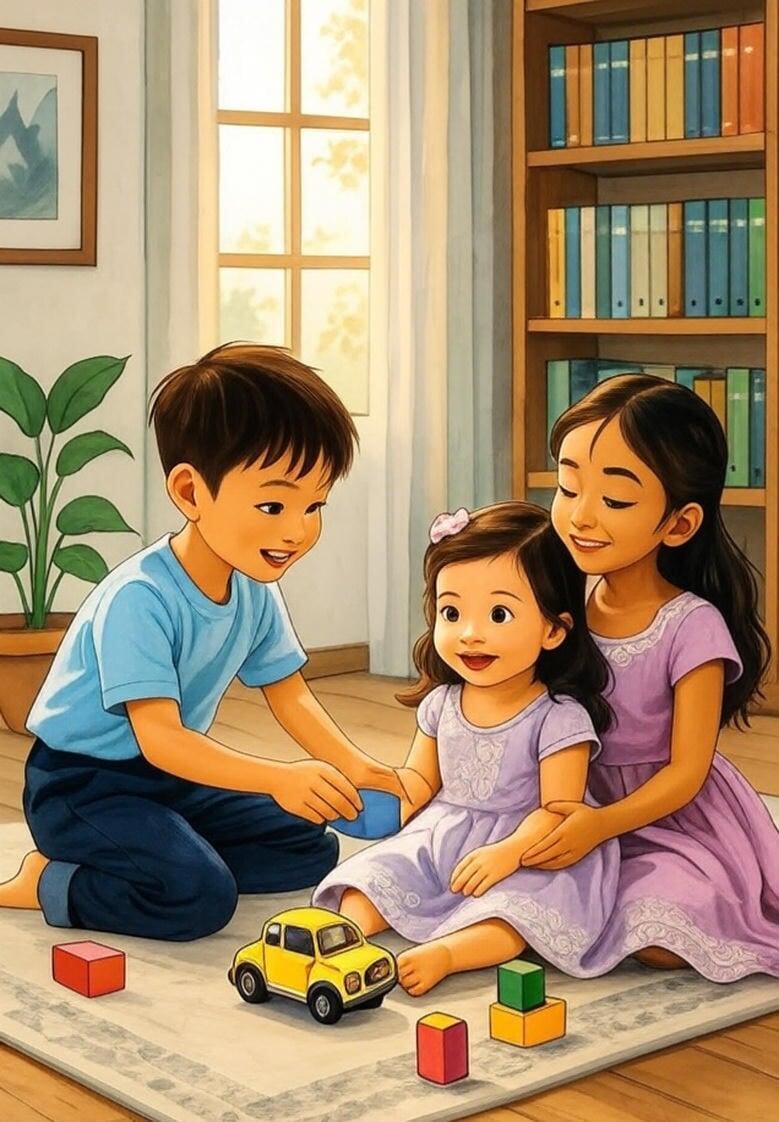
Murali was helping his little sister Hridya play with a new set of toys their parents had bought her the day before. Hridya was almost two years old and loved her toys dearly. Suddenly, the doorbell rang, and Murali's mother opened the door. It was Nadira, Murali's classmate, who lived just down the street.
Murali's mother welcomed her warmly. "Come in, sweetie!"
"Is Murali here, Auntie?" Nadira asked.
"Yes, he is! He's showing his sister how to play with her new toys. Have you had lunch?"
"Yes, thank you, Auntie." By then, Murali had come into the living room and greeted her. "Hey, Nadira!"
"Okay, kids, you three can play together now," Murali's mother said. "I need to finish preparing for next week's classes." With that, she headed to the study room.
Murali and Nadira joined Hridya, who was playing, and sat on either side of her. "Look, Hridya, who's come to see you!" Murali said. Hridya looked up from her toys, saw Nadira, and smiled sweetly. Even though she'd only met Nadira a couple of times before, she remembered her right away. Nadira gave her a gentle kiss, full of love and joy.
"How do you get to have this little queen by your side all the time, Murali?" Nadira asked, hugging Hridya. "My brother is about the same age, but he hardly ever comes near me. He cries if I get too close to him. I'm so jealous!"
"It's pretty easy, Nadira," Murali replied with a laugh. "I just stay close to Hridya all the time, so she doesn't have to come looking for me."
"Oh, come on! That's not some big secret. I try to be with my brother too, but he doesn't like it. That's the problem."
"Sometimes Hridya also gets lost in her own little world and doesn't look at me or respond. But if I start to move away, she cries right away."
"What does that mean?"
"Babies want their loved ones nearby, even when they're busy playing or exploring. Once you understand that, they'll want to stay close to you."
"But I'm sure my brother doesn't like me being around."
"Hmm... have you ever shouted at him?"
"Yes, a few times—when he messes up my things, like my books."
"Ah, I see the issue. Kids get scared and pull away from people who shout at them."
"Then how do we teach them not to spoil important things?"
"We do need to guide them, but in a gentle way."
"How?"
"At this age, they understand a simple 'No' when you say it kindly to stop them from doing something. If they pause or stop, give them a hug or kiss to show you're proud. They get that too. Remember, don't explain too much—they won't understand long talks. Just say a caring 'No,' like 'No, my good boy...' and see how they react."
"Have you tried that with Hridya?"
"Yes, lots of times! Especially when she tries to grab sharp things like pens or pencils. It works great."
"That's cool! Give me more tips on how you talk to Hridya."
"Sure. One thing Hridya loves is when I help her finish words she's trying to say."
"For example?"
"Kids learn words like 'Mom' or 'Dad' quickly. At first, when she sees Mom coming, she'd just say 'Mmm...' I'd know she meant 'Mom,' so I'd say, 'Yes, Mom! Mom is coming!' She'd smile so big, like she was saying, 'You got it!'"
Both Murali and Nadira laughed, and Hridya, not understanding why, joined in with her own sweet giggle.
"Any more tips?"
"Little kids love toys that make sounds, like rattles. Help them shake them and make noise—it's fun! You can also point to things they like and name them in a sing-song voice. For example, point to a bird or a flower or a ball and say, 'Look at that... It's a flower!' or 'Look at that... It's your ball!' Singing it like a rhyme makes them enjoy it more."
"You're like an expert! Tell me more."
"You can teach them other important things the same way."
"Like what?"
"For example, when you're washing your brother's face, sing softly as, 'Hey, my boy, I'm washing your face...' Do it over and over, and he'll start to understand both the action and the words."
"How did you learn all this?"
"Remember I told you I go on morning walks with my grandpa and his friends?"
"Yes!"
"From my Grandma, Mom and there's a pediatrician in the group, Auntie Manjula. I learned these from them."
"Thanks, Murali! I'm eager to try this at home. I really want my brother to know I love him. Do you think it'll work?"
"Absolutely, Nadira."
They spent the rest of the afternoon playing with Hridya, trying out Murali's tips. To Nadira's delight, they worked! In the evening, full of confidence and happiness, Nadira headed home.
***
Life-Skills Introduced in This Chapter
Empathy and Presence: Understanding that young children need the comforting presence of loved ones nearby, even when they're absorbed in their own activities, to build trust and closeness.
Gentle Discipline: Using a calm, caring 'No' instead of shouting to guide behavior, and following up with positive reinforcement like hugs or kisses to encourage good responses without fear.
Effective Communication with Toddlers:Helping young children complete words they're trying to say, which boosts their language skills and makes them feel understood and supported.
Engaging Play: Encouraging play with sound-making toys and pointing out/naming objects in a fun, sing-song manner to stimulate curiosity, learning, and bonding.
Teaching Through Routine: Incorporating simple songs or rhymes into everyday activities (like washing) to help children learn actions, words, and self-care enjoyably.