
A Conflict Resolved
Silence. Rain. When no answer came right away, the Teacher said, "If you're a team of good friends, it should be easy."
Years passed happily, filled with fun events. Murali was now a ninth-grade student, and Hridya had started third grade. Their schools shared the same large campus.
Every year, Murali's school celebrated its annual day in the first week of November. Hridya's school held theirs in the last week of November. Auditions for that year's events were coming up soon. Murali and his eight friends wanted to perform a group item in the fest. Hridya cheered her brother —she couldn't wait to see him on stage. Every evening on the rattling school bus, Hridya pressed her shoulder to his and whispered, “What will you do?”
“Anything,” he said, “as long as it’s excellent.”
She nodded, solemn as a judge.
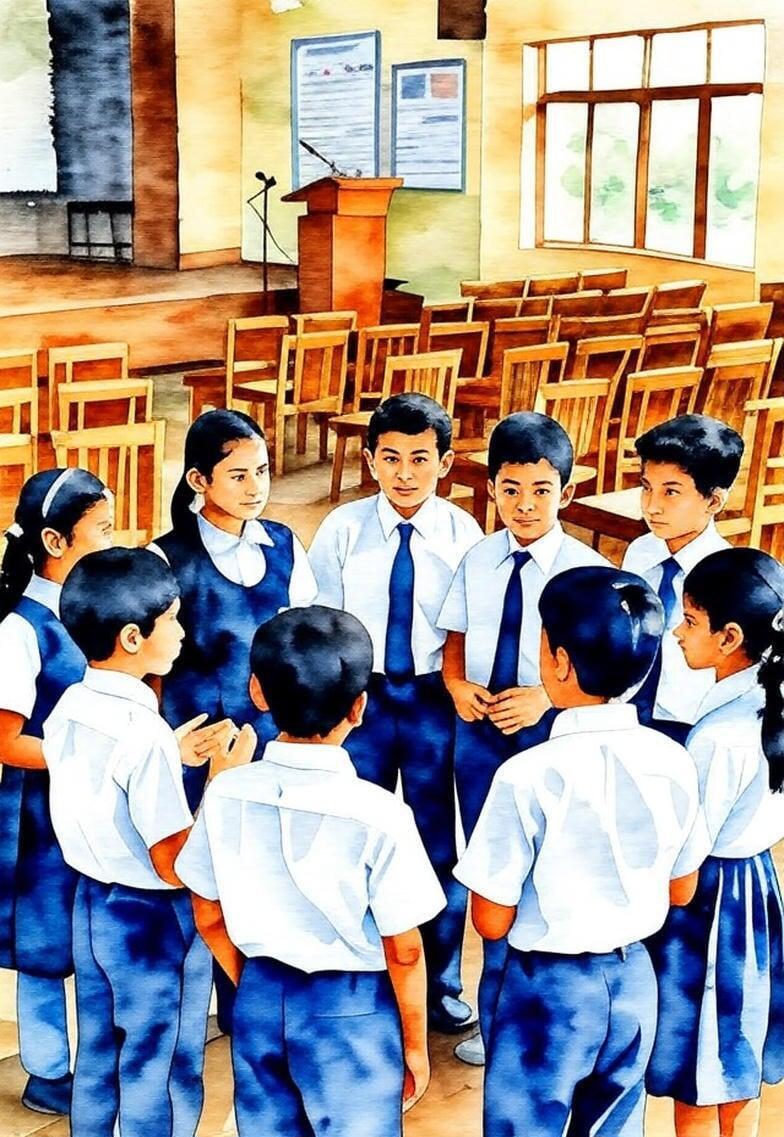
One rainy afternoon, during a free period, Murali and his friends gathered in the school auditorium to decide on their item. Rain was drumming on the tin roof like impatient fingers. Ideas ricocheted: drama, dance, mime, magic, stand-up. Voices rose, then tangled. They knew time was running out to start practicing for the audition.
"Why can't we do a drama?" one asked.
"What's wrong with a group dance?" another said.
"Is mime a bad idea?" a third wondered.
The suggestions and debates continued for a long time.
Their physical education teacher, who overheard them from afar, walked over.
"Haven't you picked anything yet? Will you decide before the end of the year?" Though he teased them at first, he quickly turned serious. "Well, kids... There are six of you... Okay... what's the first thing to think about when choosing a stage performance?"
Jonson, mud on his knees from morning practice, answered, “What are we all good at?”
“Exactly. So?”
Silence. Rain. When no answer came right away, the Teacher said, "If you're a team of good friends, it should be easy."
"Yes, sir, we are good friends," they all chimed in together.
"Then tell me your choice," the Teacher said with a smile.
They huddled again, foreheads almost touching. Minutes later they straightened.
“Mime,” they said in one breath.
"Great choice! How did you decide so quickly now?" the Teacher asked.
"Sir, you gave us the hint," Jonson explained. "As a team, we know each other's strengths and weaknesses. We’ve been miming each other for years,” Jonson grinned. “Invisible walls, fake rain, the works.”
“I’ve noticed,” the teacher said. “Even during assembly prayers.” – All laughed.
The friends got excited and dashed out into the rain. The Teacher called after them with a grin, "Hey, I won't encourage that!" But as he turned away, his own grin betrayed him—he could still taste rain on a college rooftop. His smile grew brighter.
On the bus ride home that day, Murali told Hridya they had chosen Mime. He explained what Mime was and how they'd perform it. Murali sketched invisible boxes in the air for Hridya. Her eyes widened; she traced the edges with him. “Teach me tonight,” she demanded.
“Deal,” he said, and meant it.
***
Life-Skills Introduced in This Chapter
Team Decision-Making: Discussing ideas openly in a group to reach a consensus, even when everyone has different opinions, to avoid wasting time.
Identifying Strengths: Recognizing shared talents and abilities within a team to choose activities that play to everyone's strengths.
Seeking and Applying Advice: Listening to guidance from teachers or mentors to resolve confusion and make better choices.
Resolving Conflicts: Turning debates into productive talks by focusing on common ground, reducing arguments through understanding.
Sharing and Teaching Skills: Enthusiastically passing on what you've learned to siblings or others, like teaching Mime, to build bonds and encourage growth.